

Countries cannot live in isolation. They must share prosperity and technical know-how, and trade to sell surplus products. The world economy is interdependent. A nation’s economic progress depends on its ties with other countries.
How does a country benefit from trade relations?
Countries maintain trade relations with each other. The exchange of goods and services between countries is known as international trade. A country requires a market for its goods. Markets are available locally and internationally.
A businessman or businesswoman must make a profit by selling their products in the market. They should be buyers. Without buyers, products will go to waste. Similarly, services also need to be availed of. Service providers earn income when people use their services and pay for them. In other words, both seller and buyer are important in the business process.
At the local level, citizens use services and buy products for personal consumption. At the international level, a government may play a major role in selling a product produced by an international producer. Often, you come across machinery parts and machines as well, which have been produced in another country. Garments are also exported. India exports its cotton to the Western world. In India, you also come across Taiwanese or Chinese imports, as well as those from Japan.
India vs China vs US: who sells more, who buys more?
The three economies trade in very different ways. China sells far more goods than it buys. The US buys far more than it sells. India runs a goods deficit but earns a lot from services such as IT and business support. Here are the WTO figures for the same year, 2025.
| 2025 (US$ billion) | India | China | United States |
|---|---|---|---|
| Merchandise exports (world rank) | 445 (19th) | 3,772 (1st) | 2,185 (2nd) |
| Merchandise imports (world rank) | 753 (9th) | 2,583 (2nd) | 3,507 (1st) |
| Goods trade balance | −308 | +1,189 | −1,322 |
| Commercial services exports (world rank) | 415 (8th) | 509 (4th) | 1,209 (1st) |
| Commercial services imports | 277 | 621 | 870 |
| Services trade balance | +138 | −112 | +339 |
| Share of world merchandise exports | 1.7% | 14.4% | 8.3% |
Source: WTO, Global Trade Outlook and Statistics, March 2026, Appendix Tables 1 and 3 (WTO-UNCTAD estimates). Balances calculated by us. Goods data are on a customs basis and services data on a balance-of-payments basis, so the two balances are not strictly additive. For full country data, see the WTO Stats portal.
What the numbers tell us:
- A trade deficit is not automatically a sign of weakness. The US has the world’s largest goods deficit, yet it is also the biggest services exporter. Its services surplus covers about a quarter of its goods gap.
- India’s services pay for almost half its goods deficit. A US$ 138 billion services surplus offsets about 45% of the US$ 308 billion goods gap.
- China’s surplus keeps growing. The WTO reports it rose from US$ 993 billion in 2024 to US$ 1.19 trillion in 2025, as Chinese exports moved to Europe and Asia while sales to the US fell.
Benefits of International Trade – Advantage of international trade
- Monetary gains to the respective country indulging in trade.
- More variety of goods available for consumers.
- Better quality of goods.
- Competition both at the international level as well as the local level.
- Closer ties between nations.
- More exchange of technical know-how.
- Local producers will try to improve the quality of their products.
- Increase in employment locally.
Disadvantage of international trade
- Local production may suffer
- Local industries may be overshadowed by their international competitors
- Rich countries may influence political matters in other countries and gain control over weaker nations.
- Ideological differences may emerge between nations with regard to the procedures in trade practices.
Advantages and disadvantages backed by real data
The lists above are true in theory. But how big are these effects in real life? The table below ties each one to a real example and a number you can check.
| Advantage / Disadvantage | Real-world example | Supporting data | Source |
|---|---|---|---|
| Advantage: Lower prices for consumers (seen when trade is restricted) | US tariffs on imported washing machines, 2018 | Median prices rose about US$ 86 per washer and US$ 92 per dryer. Even dryers, which had no tariff, got costlier. Consumers paid about US$ 1.5 billion more a year. | Flaaen, Hortaçsu and Tintelnot, American Economic Review (2020), via AEA |
| Advantage: New jobs and export earnings | India’s smartphone exports under the PLI scheme | Exports grew from US$ 3.1 billion in FY 2020-21 to US$ 24.1 billion in FY 2024-25. Smartphones rose from 167th place among India’s exports in 2015 to the top spot in FY 2024-25. | Outlook Business, Jan 2026; India Sea Trade News |
| Disadvantage: Job losses in exposed industries | The “China shock” in the United States | Rising Chinese import competition is estimated to have cost the US 2.0 to 2.4 million jobs between 1999 and 2011. Some economists argue the true figure is lower. | Acemoglu, Autor, Dorn, Hanson and Price, NBER (2014); Cato Institute critique |
| Advantage: Market access through trade deals | India-US interim trade deal, February 2026 | US tariffs on most Indian goods fell from 50% (from August 2025) to 18% on 2 February 2026. Engineering goods, textiles and leather were expected to gain most. | Al Jazeera, 2 Feb 2026; India Briefing |
| Disadvantage: Import dependence on one supplier | India’s medicine ingredients (APIs) from China | China’s share of India’s API imports by value rose from 68% in FY20 to about 72% in FY24. For some antibiotic inputs, such as 6-APA for penicillin, dependence is about 96%. | Business Today, Jul 2025; Madhyamam, citing government data |
| Disadvantage: Trade wars shift costs to third countries | China redirects exports after US tariffs, 2025 | China’s exports to the US fell about 20% in 2025, but its exports to other markets grew almost three times as much as it lost. Rivals in Europe and Asia faced stiffer competition. | WTO, Global Trade Outlook, March 2026 |
Case study 1: Who benefits? India’s smartphone export boom
In 2015, smartphones were a minor line in India’s export list, ranked 167th. A decade later, they were the country’s single largest export item.
The turning point was the Production Linked Incentive (PLI) scheme, launched in 2020. It paid manufacturers a share of their extra sales. Apple’s contract makers, Foxconn, Tata Electronics and Pegatron, moved iPhone assembly to India. India is the only country other than China where iPhones are made.
- Exports: Smartphone exports rose from US$ 3.1 billion in FY 2020-21 to US$ 24.1 billion in FY 2024-25 (industry estimates via Business Standard).
- Apple’s share: iPhone exports from India crossed US$ 50 billion under the PLI period by December 2025, and about 75% of smartphone exports are iPhones (Outlook Business).
- The cost: The government paid out close to ₹8,700 crore (about US$ 1 billion) in smartphone PLI incentives between FY 2022-23 and FY 2024-25 (India Sea Trade News, citing ICEA).
Who gained: factory workers in Tamil Nadu and Karnataka, component suppliers, and India’s trade balance. Who paid: taxpayers, through the incentive. The open question is how much of each phone’s value is made in India, since many components are still imported.
Case study 2: Who pays? The US washing machine tariffs
In January 2018, the US placed “safeguard” tariffs of up to 50% on imported washing machines. The goal was to protect American factory jobs from Korean and Chinese brands.
Economists Aaron Flaaen (US Federal Reserve), Ali Hortaçsu and Felix Tintelnot (University of Chicago) tracked what happened next. Their study was published in the American Economic Review in 2020.
- Prices went up. Washers rose about US$ 86 each. Dryers rose about US$ 92, even though dryers had no tariff, because the two are sold as a pair.
- Some jobs were created. Manufacturers added about 1,800 US jobs.
- At a steep price. Consumers paid about US$ 1.5 billion extra a year, while the government collected only about US$ 82 million in tariff revenue. That works out to roughly US$ 815,000 per job, every year.
Who gained: about 1,800 workers and domestic manufacturers, who raised their own prices too. Who paid: every household that bought a washer or dryer. It is a clear real-world proof of the first advantage in the list above: open trade keeps prices down.
International trade benefits the world economy. It adds to the money coffers of the world at large. Every country can benefit monetarily if it can dispose of its surplus goods after meeting the needs of its local people.
Is world trade still growing? A five-year view
Despite tariff wars, a pandemic hangover and conflicts, world goods trade has kept growing. In 2025 it reached a record US$ 26.26 trillion, according to the WTO.
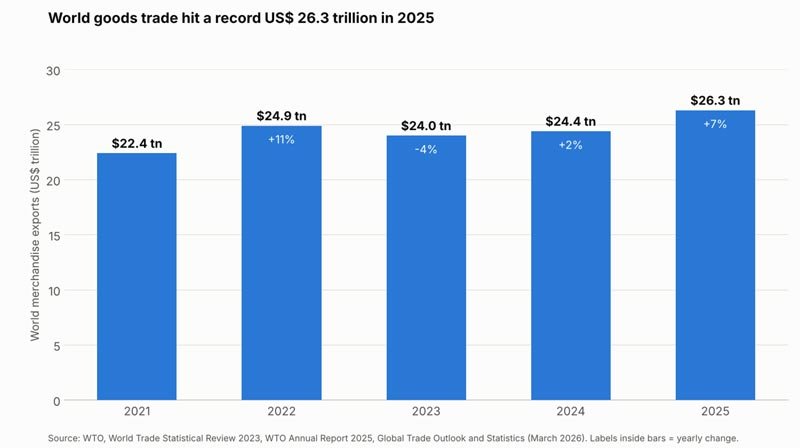
| Year | World merchandise exports | What drove it |
|---|---|---|
| 2021 | US$ 22.4 trillion | Post-Covid rebound in demand |
| 2022 | US$ 24.9 trillion | High energy and food prices after the war in Ukraine (WTO) |
| 2023 | US$ 24.0 trillion | Falling commodity prices and weak demand (WTO) |
| 2024 | US$ 24.4 trillion | Modest 2% growth in value (WTO) |
| 2025 | US$ 26.3 trillion | AI-related goods and early buying ahead of tariffs (WTO) |
Services are growing even faster. World commercial services exports reached US$ 9.56 trillion in 2025, up 8%. The WTO’s October 2026 update expects goods trade volume to grow 3.9% in 2026, helped by demand for AI equipment, even with the Middle East conflict hurting travel and transport (WTO, 8 October 2026).
What this means for you
- If you export: Don’t rely on one market. The 2025 tariff swings on Indian goods showed how fast access can change. Check tariff rates and trade agreements on the Indian Trade Portal and the DGFT website.
- If you import inputs: Keep a second supplier for critical parts. The API story shows the risk of single-country dependence.
- If you’re a student or researcher: Use primary data. The WTO Stats portal gives free country-level trade figures.
Frequently asked questions
Which country is the largest exporter in the world?
China. It exported goods worth US$ 3.77 trillion in 2025, 14.4% of the world total, per the WTO.
Which country imports the most?
The United States, with goods imports of US$ 3.51 trillion in 2025.
Does India have a trade surplus or deficit?
India runs a goods trade deficit (about US$ 308 billion in 2025) but a services surplus (about US$ 138 billion), mainly from IT and business services.

the writeup is attractive because it is self explainatory
sure?????????????
The write up is okay,its ok and it just.what i wanted short and precise.
Thanks for the sharing, it helps.
the writeup is normal but u did not show us in precise manner.. improve more.
yes,the writer is creativity with strong points
D publication is nice,bt i will like you to talk more of the political and social pressres companies face in international business
The explanation up there was cool because the point are very short and understendable so thanks to all who wrriten this.
you know i believe that international tarde has help most business people to prosper so much in their businesses because they dont only get supporter from only their country but other countries support them financially because they buy from them so this is a pure reason why is will strongly support this trading of countries becuase it brings grows to market as a whole
Peter Crouch would approve
Thanks for sharing. It was such a wonderful text of International trade.