

Some of the underdeveloped and developing countries face the problem of overpopulation. Too many mouths to feed and limited natural resources on hand can have a devastating effect on the economy. Countries like India and China have a large population. In India, population growth has outpaced what the country’s economy can handle.
The numbers have shifted recently. India passed China in 2023 to become the world’s most populous country. By the UN’s 2024 estimates, India had about 1.45 billion people in 2024 and China about 1.41 billion. The world as a whole stood at roughly 8.2 billion.
A nation’s prosperity depends on the standard of living of its people. Developed countries, such as the US with a smaller population, provide a better standard of living for their people. Americans have good food to eat and enjoy a more luxurious lifestyle than people in Southeast Asia. What are the disadvantages of overpopulation, one may ask?
Disadvantages of over population
- More mouths to feed.
- Lower standard of living.
- Poverty.
- Overcrowded cities.
- Sickness and the spread of diseases.
- Insufficient natural resources to provide adequate goods and services.
- Inadequate facilities, such as housing, medical etc.
- Starvation and a malnourished population.
- Education facilities may not meet the requirements of the entire population.
- Unemployment.
- Higher crime rates due to unequal wealth distribution and insufficient financial resources.
- Environmental pollution. Trees are felled to make space for housing facilities.
- Agricultural production is insufficient to meet the requirements of the entire population, which results in higher prices.
- Money is diverted to feed the population rather than fund fundamental research.
- Lower life expectancy.
- People in rural areas lack employment opportunities.
- Large number of people live in unhygienic conditions.
- Birth rate is high.
- Due to a lack of proper medical facilities, the death is also very high. People succumb to various diseases.
- Child labor is common. To sustain themselves, families force their children to work, rather than send them to school.
Effects of overpopulation in numbers
A list tells you what can go wrong. Data shows how big the problem really is and where it hurts most. The table below links four core effects to the latest figures from UN agencies and the World Bank, plus one real country case for each.
| Effect | Key statistic | Country example | Source |
|---|---|---|---|
| Water scarcity | 2.1 billion people (1 in 4) lacked safely managed drinking water in 2024. 3.4 billion lacked safely managed sanitation. | India has 18% of the world’s population but only 4% of its water resources. Its per capita water availability has halved since 1970. | WHO/UNICEF JMP report (Aug 2025); World Bank India water brief (Mar 2026) |
| Housing | About 2.8 billion people face some form of housing inadequacy. 1.1 billion live in slums or informal settlements, and over 300 million are homeless. | Nigeria: about 49% of city dwellers lived in slums in 2020. A World Bank study put the housing deficit at 15.56 million units in 2019. | UN-Habitat Strategic Plan 2026 to 2029 (2025); World Bank WDI; World Bank Adequate Housing Index paper (Behr et al., 2021) |
| Food | About 645 million people (7.8% of humanity) faced hunger in 2025. Africa now has more hungry people (309 million) than Asia (292 million). | India: about 172 million people (12%) were undernourished in 2022 to 2024, and 42.9% could not afford a healthy diet in 2024. | FAO, IFAD, UNICEF, WFP and WHO, SOFI 2026 (Jul 2026); SOFI 2025 (Jul 2025) |
| Employment | India will add an estimated 7 to 8 million people to its labour force every year over the next decade. | India: youth made up 82.9% of the unemployed in 2022. The jobless rate for graduates was 29.1%. | ILO and Institute for Human Development, India Employment Report 2024 (Mar 2024) |
| Energy and infrastructure | Sub-Saharan Africa connected 35 million people to electricity in 2023, but its population grew by 30 million in the same year. | Nigeria: 86.8 million people had no electricity in 2023, the largest access gap in the world. Only 61% had access. | World Bank and partners, Tracking SDG7: Energy Progress Report 2025 |
Look at the electricity row closely. It shows the real trap of fast population growth. A country can build at record speed and still stand still, because new demand eats up almost every gain.
India vs China vs Nigeria: size, density and resource pressure
These three countries are often named in the same breath when people talk about overpopulation. Yet their problems are very different. One is still growing, one has started shrinking, and one is growing faster than its systems can cope.
| Indicator | India | China | Nigeria |
|---|---|---|---|
| Population, 2024 (UN) | 1.45 billion | 1.41 billion | 232.7 million |
| Annual growth, 2024 | Under 1% | Shrinking (peaked around 2021) | About 2.1% |
| Births per woman | 2.0 (NFHS-5, 2019 to 21) | About 1.0 | About 4.4 |
| Projected population, 2050 | 1.68 billion | 1.26 billion | 359 million |
| Projected population, 2100 | 1.51 billion | 633 million | 477 million |
| Population density, 2023 (people per sq km) | 484 | 150 | 250 |
| CO2 emissions per person, 2023 | About 2 tonnes | About 8.9 tonnes | Under 1 tonne |
| Main pressure point | Water, jobs and nutrition | Ageing workforce and high consumption | Electricity, housing and food |
Sources: UN DESA World Population Prospects 2024 (population, growth, projections); World Bank WDI (density); IEA, CO2 Emissions in 2023 (India, China); Our World in Data (Nigeria); Government of India NFHS-5 (India fertility).
Population size is not the same as resource pressure
Here’s what the table shows. Headcount on its own doesn’t account for the strain on a country. There are three separate forces at play.
- Size and density. India is far more densely populated than China (over three times as many people per sq km) which is why water is India’s biggest problem. The World Bank points out that India and China together have 36% of the world’s population and only 11% of the world’s freshwater.
- Consumption. An average person in China emits over four times the CO2 of an average Indian, and many times more than a Nigerian. So a smaller, richer population can put more load on the planet than a bigger, poorer one. The same logic applies to the US, which the article mentions above.
- Infrastructure. Nigeria is not short of land. Its density is lower than India’s. Its problem is that power grids, housing and food systems are not keeping pace with about 2% yearly growth.
The bottom line is simple really. “Overpopulation” is usually just a gap between the number of people and the systems we’ve got in place to serve them. It’s as much about planning and investment as it is about birth rates.
Will the world’s population keep growing?
No, not forever. The UN’s World Population Prospects 2024 projects that the world will grow from 8.2 billion in 2024 to a peak of about 10.3 billion in the mid-2080s. After that, it should slowly fall to around 10.2 billion by 2100.
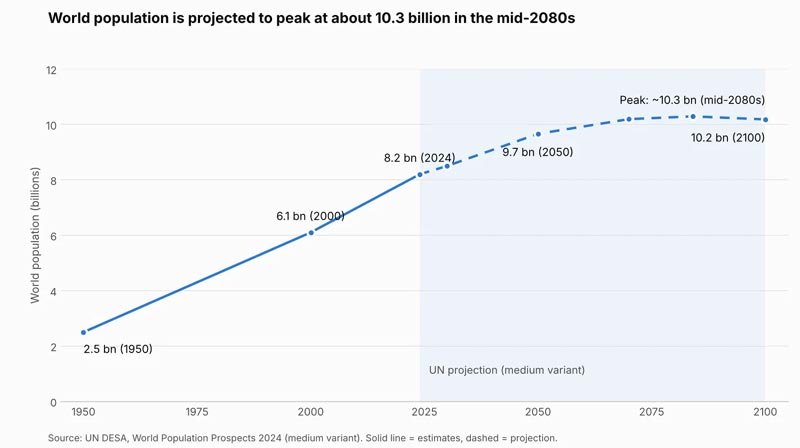
| Year | World population |
|---|---|
| 1950 | 2.5 billion |
| 2000 | 6.1 billion |
| 2024 | 8.2 billion |
| 2030 (projected) | 8.5 billion |
| 2050 (projected) | 9.7 billion |
| Mid-2080s (projected peak) | About 10.3 billion |
| 2100 (projected) | 10.2 billion |
A few points stand out from the same UN report:
- The UN puts the chance of the world’s population peaking within this century at about 80%.
- Population has already peaked in 63 countries and areas, including China, Japan, Germany and Russia.
- In 126 others, including India, Nigeria, Pakistan and the US, numbers are expected to keep rising until at least 2054.
- The 2100 figure is now about 700 million lower than the UN expected a decade ago. Falling fertility, especially in China, is the main reason.
- Women worldwide now have about one child fewer, on average, than they did around 1990.
The real challenge for the next 60 years isn’t unending growth. It’s about accommodating some 2 billion more people (primarily in South Asia and sub-Saharan Africa) whilst at the same time the more developed parts of the world see their working populations shrink as societies age.
Overpopulation is a curse to the society’s overall growth. Several countries facing this problem are trying to control their population growth. India, for example, has been introducing family planning programs to curtail the growth of its population.
What actually reduces the pressure
The evidence points to a very small number of levers that actually work and most of them are about controlling the numbers.
- Educate girls and widen access to family planning. India’s fertility rate has fallen to about 2.0, the replacement level, as schooling and health access improved. Coercion isn’t needed when choices are real.
- Manage water better rather than simply find more of it. The World Bank sees India’s problem as much more a water management one than a water availability one. Programs such as Atal Bhujal Yojana are specifically designed to address the management aspect.
- Upgrade slums rather than just clear them. UN-Habitat’s 2026-2029 strategic plan puts housing, land and basic services at the heart of the agenda. Secure tenure and access to basic services will get people’s living standards up much more quickly than simply clearing them.
- Generate jobs that require lots of workers. The ILO is calling for employment intensive growth in India with manufacturing and services that can take in millions of new entrants each year.
- Count consumption not just people. The high income countries have a much bigger footprint per person. Any sensible answer to the pressure on resources has to include a reduction in waste and emissions where the consumption is highest.
Frequently asked questions
Which country has the largest population in 2026?
India. It passed China in 2023 and the UN projects it will remain the most populous country through to 2100.
When will the world’s population peak?
The UN is projecting a peak of around 10.3bn in the mid-2080s, then a very slight decline to 10.2bn by 2100.
Is overpopulation the main cause of hunger?
Hunger fell in Asia despite the continent’s growing population, whereas in parts of Africa it went up due to the impact of conflict, climate shocks and high food prices. Distribution, income and infrastructure are just as important as the headcount.

very nice and useful information
keep up the goos work
Cool! Great info
Utter nonsense. It’s sad that in this day and age where we have almost free access to information, people still write and believe tripe such as this.
If god are giving birth to them god will give them food and help them I disagree with this SoCalled overpopulation
metyu…
this is not utter nonsense…it’s true….if u think this is crap then u might be living in a dreamworld which is not in developing countries….check out 4 your self how true this is…it’s sad that people like u refuse 2 believe the truth and have the guts to call world problems shit….
I didn’t even realize some people don’t believe how messed up our world is still in this day and age. we are still a young planet and we are still growing maybe one day we will be perfect
super information
exactly what is tripe to you? most of this is a great possibilty in our growing world. with this we can atleast be aware of the situation when it arises.
this is ok good yah
i have to do a speech about china’s overpopulation and if it is a good idea for america to do the same. i find this information very useful, thanks
Thank You!! You helped me a lot with a group project( that I mainly did)….except for the introduction paragraph.
nice and good information to the nation
who cares? nobody cares… what’s being done, nothing
everyone’s selfish
JIBS
That about sums up the problem. it’s not an issue they are dealing with so they don’t care. the sad thing is that that’s just human nature.
A bunch of selfish pigs
I strongly affirm that statement and start imagining the world if that thing will happen .look at the dark side of the future.