

Business is a risky venture. Unless an entrepreneur takes risks, they cannot make a profit. Win or lose is the name of the game. A businessman or businesswoman can either succeed in their venture or suffer many losses.
A businessman or businesswoman must take risks. It is part of the game. If they can cross these bridges, then they gain financially. If not, then they have to close down the venture and face problems in paying off debts.
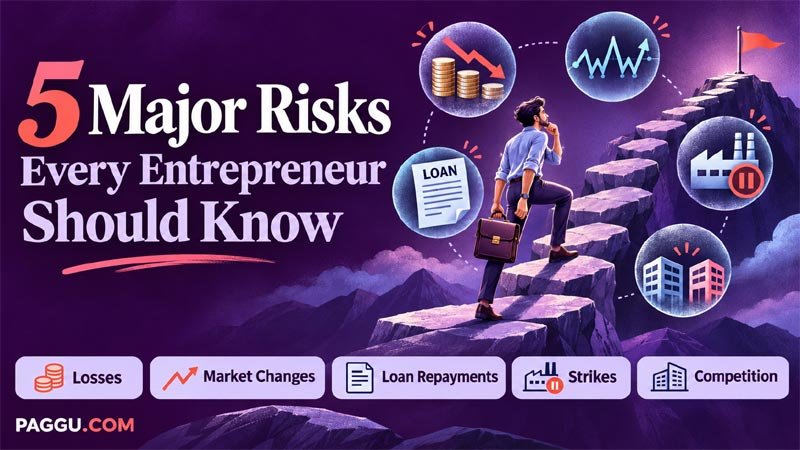
Risks of Business in Entrepreneurship
- Risk of Losses: Chances of suffering from heavy losses. A businessman or businesswoman may face setbacks if the market is unfavorable or the economy declines. A recession, for example, causes many setbacks for businesspeople. Products do not sell as individuals’ purchasing power declines. Businesspeople cannot sell their products and, as a result, cannot make profits.
- Market Fluctuations – Market does not always remain stable. It fluctuates. Many variables cause this. Steady profits may not always be there.
- Loan payments – A businessman is usually in debt as they have to borrow a lot of money to invest. Often, they suffer losses and cannot repay the loans. Debts can cause much worry.
- Strikes and Lockouts – Workers go on strike for either increased salaries or for being maltreated by management. Valuable production time is lost. An entrepreneur loses out on money on such occasions. Time is money for them.
- Competition – Stiff competition at times can wipe out a business completely. Many times small ventures cannot survive the onslaught of big ventures. The latter have money to advertise and publicize their products.
How to spot and manage each risk
Risks rarely arrive without warning. Most businesses that fail ignored small signals for months. The table below shows what to watch for with each of the five risks above, what happens if you don’t act, and how to respond.
| Risk | Early warning signs | Business impact | Mitigation |
|---|---|---|---|
| Losses | Margins shrinking for three months in a row, more discounting to close sales, stock piling up in the warehouse | Cash reserves drain, the owner starts using personal savings, and the business may have to close | Track profit per product every month. Cut or reprice lines that lose money. Keep three to six months of fixed costs in reserve. During a recession, tighten the budget early, not late. |
| Market fluctuations | Raw material prices swinging sharply; customers delaying orders; one season suddenly much weaker than last year | Unpredictable profits, overstocking or stock-outs, pricing mistakes | Spread sales across customer types and regions. Agree price-revision clauses with big buyers. Keep a rolling 12-month forecast with a “bad case” version. |
| Loan repayments | Paying EMIs from new borrowing; overdraft always near its limit; customers paying later than before | Penalties, a damaged credit score, legal action and, at worst, losing assets offered as security. Debt also brings real stress. | Borrow only against cash flow you can show, not hoped-for sales. Match the loan term to the life of the asset. Talk to the lender before you miss a payment, not after. For high-growth ideas, consider equity funding instead of debt. |
| Strikes and lockouts | Rising absenteeism; more complaints about pay or supervisors; key workers leaving | Lost production, missed delivery dates, unhappy customers and penalty clauses | Review pay against the local market each year. Set up a simple grievance channel. Recognize good work, as a reward and recognition program costs far less than a strike. Read more on the role of manpower in business. |
| Competition | Losing deals on price; a new rival opening nearby or online; fewer repeat customers | Price wars, falling market share, thinner margins | Compete on what big players can’t easily copy: service, speed, a niche or a local relationship. Use low-cost guerrilla marketing, and keep innovating on product or service. |
Calculated risk vs reckless risk
This article says an entrepreneur “loves taking risks”. That’s true of successful founders, but the risks they take are usually calculated ones. Research on US founders found that people who kept their day job while starting a business were about 33% less likely to fail than those who quit to go full time (Raffiee and Feng, Academy of Management Journal, 2014). We look at more myths like this in what makes an entrepreneur successful.
| Aspect | Calculated risk | Reckless risk |
|---|---|---|
| Starting point | Evidence: customer conversations, a pilot, a small test | A gut feeling or excitement about an idea |
| Downside | Known and capped (“If this fails, we lose ₹5 lakh”) | Unknown or unlimited (“We’ll figure it out”) |
| Money used | Amount you can afford to lose | Borrowed money, family savings or your home as collateral, all at once |
| Exit plan | A clear point to stop, change course or scale up | No stopping point. Keeps going on hope. |
| Example | A bakery owner tests a new outlet with a three-month kiosk before signing a five-year lease | The same owner signs the lease, borrows for a full fit-out and hires eight staff on day one |
A simple test: before any big decision, write down the worst realistic outcome and ask, “Can the business, and my family, survive it?” If the answer is no, shrink the bet. Structured decision-making techniques and careful opportunity evaluation help here.
Example: how falling sales hit loan repayments
The numbers below are hypothetical and only meant to show the maths.
Take a small manufacturer with a ₹30 lakh business loan at 12% interest over five years. The monthly EMI works out to about ₹66,700. It earns a 30% gross margin on sales, and its fixed costs (rent, salaries, utilities) are ₹1.8 lakh a month.
| Monthly figures (hypothetical) | Normal month | Sales down 10% | Sales down 20% | Sales down 30% |
|---|---|---|---|---|
| Sales | ₹10,00,000 | ₹9,00,000 | ₹8,00,000 | ₹7,00,000 |
| Gross profit (30%) | ₹3,00,000 | ₹2,70,000 | ₹2,40,000 | ₹2,10,000 |
| Fixed costs | ₹1,80,000 | ₹1,80,000 | ₹1,80,000 | ₹1,80,000 |
| Cash available for the loan | ₹1,20,000 | ₹90,000 | ₹60,000 | ₹30,000 |
| Loan EMI | ₹66,700 | ₹66,700 | ₹66,700 | ₹66,700 |
| Surplus or shortfall after EMI | +₹53,300 | +₹23,300 | −₹6,700 | −₹36,700 |
| Debt service coverage (cash ÷ EMI) | 1.80 | 1.35 | 0.90 | 0.45 |
Here’s the lesson. A 20% fall in sales doesn’t cut the surplus by 20%. It wipes it out completely, because fixed costs and the EMI don’t fall with sales. At 30% down, the owner must find about ₹36,700 every month from savings or new debt, which is how many businesses slide into a debt trap.
Lenders watch the last row closely. A debt service coverage ratio below 1 means the business cannot pay its loan from its own earnings. Many lenders prefer a comfortable cushion above that before they approve a loan.
What to do: run this same table for your own business before you borrow. If a 20% sales drop pushes you into a shortfall, borrow less, choose a longer tenure, cut fixed costs or build a cash reserve first.
What small businesses are struggling with now: Federal Reserve data
Note: this data is from the United States. It covers 6,525 small employer firms (1 to 499 employees) surveyed between 3 September and 14 November 2025, and was published in March 2026. India-specific data of this kind is limited, but the pressures are familiar to Indian small businesses too.
- Rising costs were the top financial worry. Higher costs of goods, services and wages were the most common financial challenge in the prior 12 months. More than four in 10 firms also struggled with tariff-related costs, and 77% faced one or both problems.
- Tariffs hit retail and manufacturing hardest. Tariff-related cost problems were reported by 69% of retail firms and 62% of manufacturers.
- Finding customers was the top operational challenge. Reaching customers and growing sales came first, ahead of hiring and keeping good staff.
- Most passed on part of the cost. Among firms whose imported inputs got costlier, 76% passed some of the increase to customers and 60% absorbed some of it themselves.
- Expensive quick loans. 60% of firms that borrowed from online lenders said the real borrowing cost was higher than they expected.
- Confidence slipped. The survey’s revenue expectations index fell from 39 to 33 in a year.
Source: Federal Reserve Banks, 2026 Report on Employer Firms: Findings from the 2025 Small Business Credit Survey. The Fed notes this is a convenience sample, not a random one, so results may carry some bias.
The link to this article’s five risks is direct. Rising costs squeeze margins (risk of losses), tariff swings are a modern form of market fluctuation, and costly quick loans make repayment harder. The fact that “reaching customers” tops the list shows why competition remains a risk for small firms.
A business without risks is not business at all. An entrepreneur loves taking risks. They get many thrills in venturing into unknown domains.
Risks today: three threats that didn’t make the 2009 list
1. Cybersecurity
A single ransomware attack can freeze billing, orders and customer data for days. Small firms are a favourite target because they often lack security teams. Verizon’s analysis of 12,195 confirmed data breaches found ransomware in 88% of breaches at small and medium-sized businesses, compared with 39% at large organisations (Verizon Data Breach Investigations Report, 2025).
Basic defences: turn on two-factor login for email and banking, keep software updated, back up data offline every week, and train staff to spot phishing messages. Even your choice of secure messaging apps matters when sharing business data.
2. Supplier dependence
Relying on one supplier or one country for key inputs is a hidden risk until something breaks. Nearly half of US small employer firms in the Fed survey source some inputs from abroad, and tariff changes in 2025 raised costs for many of them. Indian businesses face their own version. For example, China’s share of India’s imported active pharmaceutical ingredients rose to about 72% by value in FY24 (Business Today, July 2025). See also our piece on the advantages and disadvantages of international trade.
Basic defenses: Keep at least two suppliers for critical items, hold extra stock of items with long lead times, and review supplier risk every quarter.
3. Regulatory changes
New rules can add costs overnight. In India, the Digital Personal Data Protection Rules were notified in November 2025. Most business obligations, such as consent notices, security safeguards, and breach reporting, apply from around May 2027. Penalties can reach ₹250 crore for failing to protect personal data (PIB, November 2025). Any business that collects customer names, phone numbers, or emails should start preparing now.
Basic defenses: Assign one person to track rule changes in your sector, budget for compliance each year, and get professional advice before major changes.
Your quick risk checklist
- Do I know my monthly break-even sales figure?
- Can the business pay its EMIs if sales fall 20%?
- Do I have at least three months of fixed costs in reserve?
- Does any single customer or supplier account for more than a third of my business?
- Are my data backed up, and is two-factor login switched on?
- Do I know which new regulations apply to my business this year?
Any “no” is a risk worth fixing this month. Many of these traps also appear in our list of top mistakes entrepreneurs make. For a wider view, read how entrepreneurs handle business risk and uncertainty, and the personal costs of entrepreneurship.
Frequently asked questions
What are the major risks for an entrepreneur?
The classic five are losses, market fluctuations, loan repayments, strikes, and competition. Today, cybersecurity, supplier dependence and regulatory change matter just as much.
How can a small business reduce loan repayment risk?
Borrow only what your current cash flow can repay, test your EMI against a 20% sales drop, keep a cash reserve, and speak to your lender early if trouble starts.
What is the difference between calculated and reckless risk?
A calculated risk has a known, affordable downside and a clear exit point. A reckless risk bets money you can’t afford to lose, with no plan to stop.
