

Fresh looks, fresh legs, tons of imagination, and an outrageously passionate approach to their work are some attributes that are vibrantly visible in entrepreneurs. So what makes these bright men and women ignite so much talent and stand out from the rest? What makes their methods unique or exclusive? These individuals have definitely checked off some key areas that give them the mileage to lead an enterprise. Let us discuss some vital differences and additional information that matters for anyone considering venturing out as an entrepreneur.
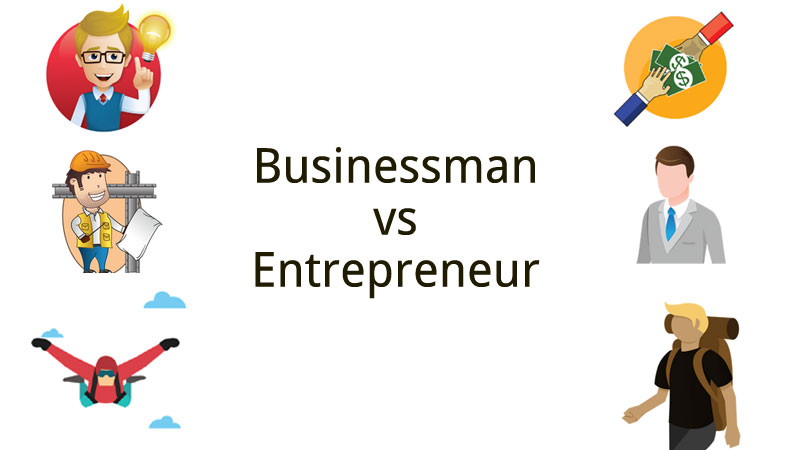
A businessman runs a business based on an existing idea or model and aims for steady profit. An entrepreneur starts with a new idea, takes bigger risks, and tries to create a new market or solve a fresh problem. Every entrepreneur runs a business, but not every businessman is an entrepreneur.
Key Differentiators Between Entrepreneur and Businessman

Before we go deep into the top 5 differences between Entrepreneur and Businessman, lets have a look at some of the top ones –
| Aspect | Businessman | Entrepreneur |
|---|---|---|
| Definition | Runs a business using existing ideas or models. | Creates and runs a business with new and unique ideas. |
| Approach | Follows customary methods and avoids risks. | Introduces innovations and accepts risks. |
| Objective | Focuses on earning profit. | Aims to solve problems and create value while earning profit. |
| Vision | Thinks short-term and focuses on stability. | Thinks long-term and focuses on innovation. |
| Risk-Taking | Takes calculated risks and avoids uncertainties. | Takes daring risks for higher rewards. |
| Idea Source | Works within existing market patterns. | Develops original ideas or concepts. |
| Competition | Competes with others in the same market. | Creates new markets with less or no competition. |
| Creativity | Follows proven methods and practices. | Uses creative thinking and experimentation. |
| Decision-Making | Relies on information and market trends for decisions. | Relies upon intuition and creative thinking. |
| Role in the Economy | Sustains businesses and provides jobs. | Drives growth through innovation and new opportunities. |
| Ownership of Ideas | Implements ideas from others or the market. | Creates and owns new ideas. |
| Growth Perspective | Focuses on steady and linear growth. | Seeks rapid and significant growth. |
| Mindset | Thinks like the manager of a proven system. | Thinks like a creator who questions how things are done. |
| Use of Profit | Takes profit out as income or keeps it as a safety reserve. | Puts most of the profit back into the product, team and growth. |
| Scale and Reach | Usually serves a local or limited market. | Builds something that can scale to a national or global market. |
| View of Failure | Sees failure as a loss to avoid. | Sees failure as a lesson and a step toward the next attempt. |
| Examples | Franchise owners and traditional retailers. | Startup founders and inventors. |
Businessman vs Entrepreneur: Indian Examples
Real names make the difference easier to see. The table below compares common business types with well-known Indian founders.
| Type | Example | Why It Fits |
|---|---|---|
| Businessman | A neighbourhood kirana store owner | Sells known products to a known local market. Income is steady and the model rarely changes. |
| Businessman | A franchise owner of a food chain | Runs a brand, menu and process that someone else built and tested. |
| Businessman | A family-run textile trader | Follows a trading model inherited through generations. |
| Entrepreneur | Ritesh Agarwal (OYO Rooms) | Started very young with the idea of standard, branded budget hotel rooms. That model did not exist at scale in India. |
| Entrepreneur | Falguni Nayar (Nykaa) | Left a senior banking career to build an online beauty marketplace from scratch. |
| Entrepreneur | Kiran Mazumdar-Shaw (Biocon) | Started a biotech company from a garage in Bengaluru when the industry barely existed in India. |
Some people move from one group to the other. Dhirubhai Ambani started as a small yarn trader, a classic businessman. He then built Reliance by entering new industries, which is entrepreneurship.
Top 5 Differentiators Between Entrepreneur and Businessman
1) Original Ideation
It is generally acknowledged that a good businessman is interested in his products out in the market and always compares them with similar products in the market floated out by business rivals. In contrast, an entrepreneur is 9 out of 10 times keenly interested in investing their time in imagining something new, something out of the box. Willing to take the path untaken, this is what makes the difference. Instead of choosing an existing solution and making small amendments, the preferred choice now is to find an idea that has never been executed before.
2) Inherent risk taking
While all businesspeople take risks in their own domain, and day-to-day operations and investments carry their own risks, entrepreneurs’ risks often involve high-stakes decisions that can have compounding effects. For example, an entrepreneur may run a unit or propose building one with less capital because his products are not yet tried and tested in the market. Still, most of the time, the capital invested comes from savings or borrowed funds; failing to realize appropriate returns quickly may set the individual back for a few years, or worse, bury everything that was ever started.
3) People Management
Another factor that differentiates a business person from that of an entrepreneur is the way his team is handled. As an organization grows, a businessman thinks about how to hire people who strengthen the vision and increase overall productivity. An entrepreneur is often focused on getting his team to be more productive than ever and produce more effectively rather than just efficiently. Entrepreneurs focus on empowering their teams with decision-making and a variety of tools so they can deliver with less, hence, productivity is derived from forming a leaner staff.
4) Accepting change
One thing is constant in the world we live in: change. Everything around us changes,, and this affects everything connected to financial systems, too. Entrepreneurs feed on change, they breathe and swear by the principle that change is for the good. Readiness to change everything when needed gives entrepreneurs an lead in the market. It’s a different story with most people in business, since they bask in the glory of an earlier formula that worked well and strongly believe it shouldn’t be altered too much to upset an existing customer base and its acceptance in the current market.
5) Revenue Growth
Another aspect that differentiates the mode of operation between a businessman and an entrepreneur is how revenue is generated. While pushing for returns is a criterion for both categories to achieve, a typical businessman is interested in the compounding value of the revenue that is generated. On the other hand, an entrepreneur may keep improving a product or their team’s skill set, taking a long-term view and hoping to grow their investment over time.
Most entrepreneurs start small and face tons of difficulties before they find their mojo. Persistence, dedication, and the ability to see the bigger picture carry them through. Many inspiring true-life stories show ordinary people working their way up to become great entrepreneurs, whether in entertainment or product sales; the journey proves full of energy and challenges.
The principles and education derived from this experience are truly priceless. Modernizing the world with innovative, creative thinking is often the best acknowledgment. Transforming an individual to learn more deeply and build a small team. This individual grows into a successful business person or an industrialist, bringing greater rewards to many.
Similarities Between a Businessman and an Entrepreneur
The two roles overlap more than most people think. Both of them:
- Invest money, time or both to earn a return.
- Take some level of risk.
- Hire, lead, and manage people.
- Need customers, sales and cash flow to survive.
- Create jobs and add to the economy.
The real gap lies in the idea, the level of risk, and the long-term goal.
Quick Self-Check: Are You More of a Businessman or an Entrepreneur?
Answer these five questions honestly. Mostly “A” points to a businessman mindset. Mostly “B” points to an entrepreneur mindset.
| Question | A | B |
|---|---|---|
| Where do your ideas come from? | What already sells well | Problems no one has solved yet |
| How do you see risk? | Keep it low and safe | Accept it for a bigger reward |
| What do you do with profit? | Take it home or save it | Put it back into growth |
| How do you react to failure? | Avoid it at all costs | Learn from it and try again |
| What does success look like? | A stable, steady business | A new product or a new market |
Neither answer is wrong. A healthy economy needs both types.
Frequently Asked Questions
Is every businessman an entrepreneur?
No. Every entrepreneur runs a business, but not every businessman is an entrepreneur. A businessman can run a profitable shop or franchise without creating anything new. An entrepreneur is defined by a new idea and the risk of testing it.
Can a businessman become an entrepreneur?
Yes. A businessman becomes an entrepreneur when he starts a new venture, launches a new product or enters a market that doesn’t exist yet.
Who takes more risk, a businessman or an entrepreneur?
An entrepreneur usually takes more risk. The idea is untested, so demand isn’t proven. A businessman’s risk is mostly about daily operations and competition.
Who earns more, a businessman or an entrepreneur?
There is no fixed answer. A businessman often earns a steady income sooner. An entrepreneur may earn little in the early years but can earn far more if the idea succeeds.
Is a startup founder an entrepreneur?
Yes, in most cases. A startup is built around a new product, service or business model, and that is the core of entrepreneurship.
Which is better, being a businessman or an entrepreneur?
Neither is better. It depends on your risk appetite, your goals, and the kind of work you enjoy.
