

‘One who undertakes an endeavor’ is the meaning of the French word entrepreneur. It is really all about starting something and making it prosper while offering people the services and products they need. This word was not commonly utilized until the late 19th century to the early 20 century. Before looking at the actual history of this practice, it is vital to really understand what it entails today. It is the process in which entrepreneurs are able to bring different resources and innovations to influence society and interact in the name of business. Those who establish these ventures may start from scratch or may use other ventures and take them to greater heights.
The word comes from the French verb entreprendre, which means “to undertake”. Irish-French economist Richard Cantillon gave it an economic meaning around 1730. French economist Jean-Baptiste Say made it popular in 1803.
Mot people have seen entrepreneurship as a difficult thing to get into. This is for a reason because most ventures that are started will actually fail even without taking off. Therefore, there is great need to recognize this and to learn all the lessons that are vital for success. There are certain people that are known to have contributed to the popularity and emergence of entrepreneurship.
The numbers agree. In the United States, about 20% of new businesses close within their first year. Roughly half close within five years (Source: U.S. Bureau of Labor Statistics).
So if your first idea flops, you’re in very large company.
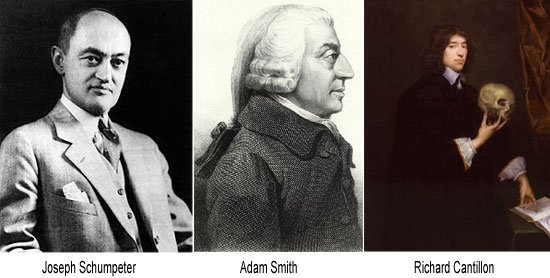
Among them was Joseph Schumpeter, Adam Smith and Richard Cantillon and others that have contributed greatly to the development of this idea and indeed the success and boom of it in the present day.
Timeline: How the Gurus Shaped Entrepreneurship
Today’s founders stand on the shoulders of giants. Here’s who said what, and when.
| Year | Thinker | Work | Key idea |
|---|---|---|---|
| c. 1730 (published 1755) | Richard Cantillon | Essai sur la Nature du Commerce en Général | The entrepreneur buys at a known price and sells at an unknown price. That gap is the risk. |
| 1776 | Adam Smith | The Wealth of Nations | Self-interest and free markets create wealth. Smith wrote about “undertakers” and capital owners, not entrepreneurs. |
| 1803 | Jean-Baptiste Say | A Treatise on Political Economy | The entrepreneur combines land, labour and capital to make a product. |
| 1871 | Carl Menger | Principles of Economics | Founded the Austrian School. Value comes from what people want, not from labour alone. |
| 1911 | Joseph Schumpeter | The Theory of Economic Development | The entrepreneur is an innovator who creates new combinations. |
| 1921 | Frank H. Knight | Risk, Uncertainty and Profit | Profit is the reward for bearing uncertainty that no one can measure. |
| 1942 | Joseph Schumpeter | Capitalism, Socialism and Democracy | Introduced “creative destruction”. New products destroy old industries. |
| 1949 | Ludwig von Mises | Human Action | Every person acts as an entrepreneur when acting under uncertainty. |
| 1973 | Israel Kirzner | Competition and Entrepreneurship | Entrepreneurs are alert to opportunities that others miss. |
| 1983 | Howard Stevenson (Harvard) | Harvard Business School teaching | Entrepreneurship means chasing opportunity beyond the resources you control. |
| 1985 | Peter Drucker | Innovation and Entrepreneurship | Entrepreneurship is a discipline anyone can learn. Innovation is its main tool. |
(Source: Wikipedia)
These great people were economists that saw the need to highlight the possibilities and opportunities that would later prove to be worthwhile. There were other great economists from Austria who contributed and in the 1940s; it was the blink of a revolution that would see many look this direction.
Carl Menger is just an example of an Austrian economist whose work has been followed keenly for playing a part in helping the history of entrepreneurship. Schumpeter is famous for having an excellent definition for an entrepreneur which is as follows. According to him, an entrepreneur is a person willing to convert an idea into innovations.
Schumpeter’s 5 Types of Innovation
Joseph Schumpeter (1883 to 1950) was born in Austria and later taught at Harvard. In 1911, he listed five ways an entrepreneur innovates.
- New product: A good that customers haven’t seen before, like the first smartphone.
- New method of production: A better way to make something, like Ford’s moving assembly line in 1913.
- New market: Selling to buyers nobody served before.
- New source of supply: A new raw material or supplier.
- New organisation: A new industry structure, such as creating or breaking a monopoly.
This is basically what great entrepreneurs of all time have done making their venture pretty profitable. This ancient expert came up with the ‘the gale of creative destruction’ which according to him was employed by entrepreneurship. This basically means creating new innovations that will take over the old and maybe more inferior models. This insight has been shared throughout the years as one of the biggest breakthroughs that brought to reality the essence of entrepreneurship. It is through this creative destruction that industries were formed to be dynamic and were able to grow and progress.
You’ve seen creative destruction in your own pocket. Digital cameras wiped out film rolls. Then smartphones wiped out most digital cameras. Kodak, the company that built the first digital camera in 1975, filed for bankruptcy in 2012.
The scholars and experts who helped demystify entrepreneurship seemed to agree on several things. It is through this knowledge that this idea was birthed and has been sustained through different rules of play. They agreed that entrepreneurship was about risk which was defined in different ways. They all seemed to agree on the ambiguity of the ventures. Frank H. Knight is popular with his classifications that centered on risk and uncertainties thereof. There are many other principles that were brought together to create and define entrepreneurship as we know it.
Knight’s Risk vs Uncertainty
Frank Knight taught at the University of Chicago. His 1921 book split the unknown into two kinds.
| Point | Risk | Uncertainty |
|---|---|---|
| Can you measure it? | Yes, with data and probability | No, there’s no past data |
| Can you insure it? | Yes | No |
| Example | Chance of a shop fire | Will customers want a product that doesn’t exist yet? |
| Who earns the reward? | Insurance companies | Entrepreneurs, through profit |
Comparing the Entrepreneurship Gurus
Each guru looked at the same person, the entrepreneur, through a different lens. This table puts their views side by side.
| Thinker | Country | Entrepreneur’s main role | Focus | What it means for you today |
|---|---|---|---|---|
| Richard Cantillon | Ireland / France | Risk-taker | Price gaps in markets | You earn because you accept risk others avoid |
| Adam Smith | Scotland | Capital owner | Markets and division of labour | Free markets reward useful work |
| Jean-Baptiste Say | France | Coordinator | Combining resources | Good management turns inputs into value |
| Carl Menger | Austria | Planner of production | Customer wants and value | Value starts with what buyers want |
| Frank H. Knight | USA | Bearer of uncertainty | Profit as a reward | Profit comes from bets nobody can insure |
| Joseph Schumpeter | Austria / USA | Innovator and disrupter | Creative destruction | New ideas replace old industries |
| Israel Kirzner | UK / USA | Alert opportunity-spotter | Noticing missed gaps | You don’t need an invention, just sharp eyes |
| Peter Drucker | Austria / USA | Systematic innovator | Discipline and practice | Anyone can learn entrepreneurship |
Schumpeter and Kirzner disagree in an interesting way. Schumpeter’s entrepreneur shakes up the market. Kirzner’s entrepreneur spots a gap and closes it.
Which one sounds more like you?
My view is clear. Drucker’s idea matters most for founders today. Most successful businesses I’ve seen didn’t invent anything. They noticed a gap and worked on it with discipline, every single day.
Peter Drucker’s 7 Sources of Innovation
Drucker (1909 to 2005) was born in Vienna and taught in the US. In his 1985 book, he listed seven places to look for opportunities.
- The unexpected success or failure
- A gap between what is and what should be
- A need inside a process
- Changes in industry or market structure
- Changes in population (demographics)
- Changes in how people see things
- New knowledge, scientific or technical
Drucker ranked new knowledge last for a reason. It’s the riskiest and slowest source of innovation.
History of Indian Entrepreneurship
India’s business story is thousands of years old. It didn’t start with startups in Bengaluru.
Traders from the Indus Valley sold goods to Mesopotamia around 2500 BCE. Kautilya’s Arthashastra, written around 300 BCE, set rules for trade, prices and merchant guilds called shrenis.
Later, merchant communities built trading networks across Asia. Gujarati, Marwari, Chettiar and Parsi families ran trade, banking and money-lending for centuries.
Timeline of Indian Entrepreneurship
| Year | Event | Why it mattered |
|---|---|---|
| c. 2500 BCE | Indus Valley trade with Mesopotamia | One of the world’s earliest trade networks |
| c. 300 BCE | Kautilya writes the Arthashastra | Early rules for trade and merchant guilds |
| 1868 | Jamsetji Tata starts a trading company in Bombay | The start of the Tata Group |
| 1907 | Tata Iron and Steel Company (now Tata Steel) founded | Indian-owned heavy industry under British rule |
| 1951 | Industries (Development and Regulation) Act | Start of the “Licence Raj”; firms needed permits to grow |
| 1981 | Infosys founded in Pune | Seven founders started with ₹10,000, borrowed from Sudha Murty |
| 1991 | Economic reforms (LPG) | Ended most industrial licensing and opened India to foreign investment |
| 2007 | Flipkart founded in Bengaluru | Walmart bought a 77% stake for US$16 billion in 2018 |
| 2011 | InMobi becomes India’s first unicorn | A startup valued at US$1 billion or more |
| 2016 | Startup India launched on 16 January; UPI launched | Tax breaks, easier compliance and cheap digital payments |
| March 2026 | Over 2.23 lakh DPIIT-recognised startups | India becomes one of the world’s largest startup ecosystems |
The 1991 Reforms: When the Licence Raj Ended
Before 1991, starting a factory meant years of red tape. Businesses needed government licences to set up, expand, or even change products.
In 1991, India faced a balance-of-payments crisis. Foreign exchange reserves could pay for only about three weeks of imports (Source: Wikipedia).
Prime Minister P. V. Narasimha Rao and Finance Minister Manmohan Singh responded fast. Singh presented the reform budget on 24 July 1991.
- Liberalisation: Industrial licensing ended for all but a short list of sectors.
- Privatisation: The government reduced its control of public sector companies.
- Globalisation: Import duties fell, and foreign companies could invest more easily.
The effect on entrepreneurs was huge. IT firms like Infosys, Wipro and TCS could now win foreign clients and grow without licences.
Startup India: The Numbers
Prime Minister Narendra Modi launched Startup India on 16 January 2016. The scheme gives recognised startups tax breaks, faster patent filing and easier compliance.
The growth since then has been remarkable.
- Over 2.23 lakh startups held DPIIT recognition as of 31 March 2026.
- More than 55,200 startups got recognition in FY26 alone, a record for any single year.
- Recognised startups report over 23.36 lakh direct jobs.
(Source: Inc42)
India also had 61 unicorns in the Hurun Global Unicorn Index 2026. That ranked India fourth, after the United States, China and the United Kingdom (Source: Drishti IAS). Other trackers count differently, so you’ll see higher numbers elsewhere.
| Point | Before 1991 | 1991 to 2015 | Since 2016 (Startup India) |
|---|---|---|---|
| Starting a business | Licences and long approvals | Most licences removed | Online registration and DPIIT recognition |
| Typical founders | Business families | Engineers and IT professionals | Students, techies and small-town founders |
| Main funding | Family money and bank loans | Early venture capital | Angels, VCs and government fund of funds |
| Big sectors | Textiles, steel, trading | IT services, telecom | Fintech, e-commerce, SaaS, AI |

very clear and understood….i really wanted that..thanx.
Thanks for sharing..its help me a lot in my study…. keep it up..God bless…