

An entrepreneur must have certain cultivated and inherent qualities to succeed in their venture. Not everyone can be a successful businessman or businesswoman. Hard work and determination to win have helped many successful businesspeople reach their goals.
Quick Answer: 3 Competencies of an Entrepreneur
- Opportunity-seeking and initiative: spotting a need and acting on it before others do.
- Engaging in calculated risks: weighing the odds and then committing time and money.
- Persistence: continuing to work on the goal even after failures and obstacles.
These three come from the 10 Personal Entrepreneurial Competencies (PECs) model, explained further below.
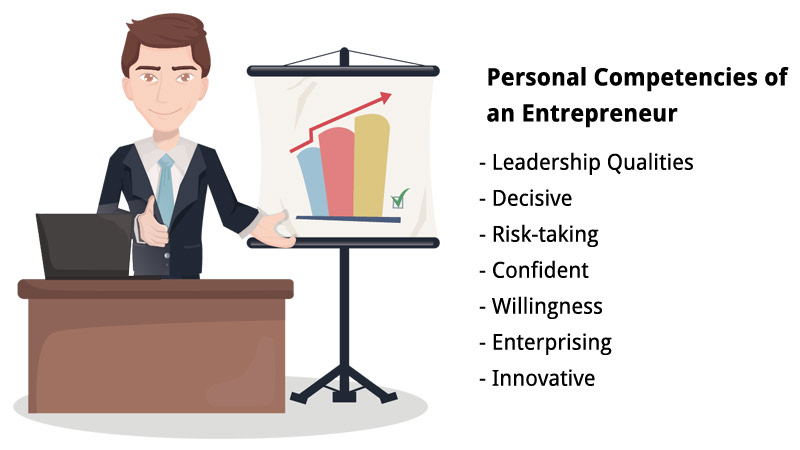
Personal competencies of a successful businessman or woman
- Leadership qualities – A businessman or woman must be able to lead their staff members as well as other associates. They must be able to guide others in carrying out business and make it a success.
- Decisive – A successful businessman or woman has to be very decisive. They sometimes have to make key decisions on the spot. Any vacillation in decisions could affect their business. They must be firm in their decisions. Also, while making decisions, they must not be influenced by others. They should be able to take decisions independently.
- Risk-taking – Business involves many risks, which a business person must not hesitate to take. There is considerable financial investment, so one must be careful with investments. Yet risks must also be taken in financial matters. Sometimes a businessman may lose out on their venture, but when they make a success of it then they have much to gain, both financially and from a personal satisfaction point of view.
- Confident – Achieving success in business requires confidence. A businessman or businesswoman must be confident to reach set targets. Diffidence does not help. Self-image is enhanced when one is confident.
- Willingness – A businessman or businesswoman must be willing to undertake any matters concerning their business venture. They must not hesitate for personal or other reasons. Willingness to extend a helping hand is very essential.
- Enterprising – One has to be enterprising to achieve significant results in business. They must have the zeal to get things done. A relaxed approach will not help.
- Innovative – New ideas help make a business venture successful. A successful businessman or woman must be innovative and always strive for something better. New concepts must be formulated, and new ways of doing business must be thought of.
A businessman or woman must be highly competent to climb the ladder of success. Certain attributes are essential for them to establish their business on a sound footing.
The 10 Personal Entrepreneurial Competencies (PECs) Model
The qualities above are common sense. Research backs many of them too. In the 1980s, Harvard psychologist David McClelland’s firm, McBer and Company, worked with Management Systems International (MSI) on a USAID-funded study. The goal was to find what separates successful entrepreneurs from average ones.
The study produced 10 Personal Entrepreneurial Competencies, or PECs. They fall into three clusters: Achievement, Planning and Power. The United Nations’ Empretec program still uses this model to train entrepreneurs in many countries.
| Cluster | Competency (PEC) | What It Means |
|---|---|---|
| Achievement | 1. Opportunity-seeking and initiative | Acts before being asked or forced by events. Spots new business chances. |
| Achievement | 2. Persistence | Keeps trying, or changes the plan, when faced in the face of obstacles. |
| Achievement | 3. Fulfilling commitments | Does whatever it takes, even personal sacrifice, to finish a job on time. |
| Achievement | 4. Demand for quality and output | Wants work done better, faster, or cheaper. Sets high standards. |
| Achievement | 5. Taking measured risks | Weighs the odds, then takes moderate risks and works to reduce them. |
| Planning | 6. Goal-setting | Sets clear, measurable short-term and long-term goals. |
| Planning | 7. Information-seeking | Researches customers, suppliers and competitors personally. Asks experts. |
| Planning | 8. Systematic planning and monitoring | Breaks big goals into steps, tracks progress and changes course when needed. |
| Power | 9. Persuasion and networking | Influences people and builds contacts that help reach business goals. |
| Power | 10. Independence and self-confidence | Trusts own judgement and sticks to decisions, even against opposition. |
Real Examples of Each Competency
Here is one well-known entrepreneur or business for each of the 10 PECs.
- Opportunity-seeking and initiative: Ritesh Agarwal (OYO Rooms). He noticed how poor and unpredictable budget hotel rooms in India were while traveling. He turned that dilemma into a branded budget-stay business.
- Persistence: James Dyson. He built thousands of prototypes over several years before his bagless vacuum cleaner worked. Most people would have stopped after a few failures.
- Fulfilling commitments: Elon Musk (Tesla). During the 2018 Model 3 production crisis, he said in interviews that he was sleeping at the factory to fix problems and meet output targets.
- Demand for quality and output: Dr Devi Shetty (Narayana Health). He applied high-volume, assembly-line efficiency to heart surgery. This cut costs sharply without lowering clinical standards.
- Executing calculated risks: Mukesh Ambani (Reliance Jio). He invested heavily in a nationwide 4G network before Jio earned any revenue. The bet was backed by data on India’s growing smartphone use.
- Goal-setting: Ratan Tata (Tata Nano). He set a public, measurable goal: a family car priced at about one lakh rupees. The whole engineering team worked backward from that target.
- Information-seeking: Jeff Bezos (Amazon). Before starting Amazon, he studied how fast web use was growing and listed products that could sell online. He picked books because there were millions of titles and they were easy to ship.
- Systematic planning and monitoring: The Mumbai Dabbawalas. Thousands of workers deliver lunch boxes across the city every day using a simple colour and number code. They plan and check every hand-off, so very few boxes go missing.
- Persuasion and networking: Steve Jobs (Apple). He convinced John Sculley to leave PepsiCo by asking, “Do you want to sell sugared water for the rest of your life, or do you want to come with me and change the world?”
- Independence and self-confidence: Kiran Mazumdar-Shaw (Biocon). She started Biocon in 1978 from a garage in Bengaluru. She has said banks were reluctant to lend to a young woman in a new industry, but she went ahead anyway.
How the 7 Qualities Above Match the PECs Model
The seven qualities in this article line up closely with the research-based PECs.
| Quality in This Article | Closest PEC |
|---|---|
| Leadership qualities | Persuasion and networking |
| Decisive | Independence and self-confidence |
| Risk-taking | Taking measured risks |
| Confident | Independence and self-confidence |
| Willingness | Fulfilling commitments |
| Enterprising | Opportunity-seeking and initiative |
| Innovative | Opportunity-seeking and initiative; Demand for quality and capability |
Three PECs are not covered by the list above: goal-setting, information-seeking, and systematic planning and monitoring. These planning skills are often what turn a bold idea into a lasting business.
Self-Assessment: Rate Your Personal Entrepreneurial Competencies
Read each statement and give yourself a score from 1 to 5.
- 1 = Never
- 2 = Rarely
- 3 = Sometimes
- 4 = Usually
- 5 = Always
| # | Statement | Competency | Your Score (1 to 5) |
|---|---|---|---|
| 1 | I act on new ideas or chances before others do. | Opportunity-seeking and initiative | |
| 2 | When something fails, I try again or try a different way. | Persistence | |
| 3 | I finish what I promise, even if it means extra hours. | Fulfilling commitments | |
| 4 | I am not happy until work meets a high standard. | Demand for quality and output | |
| 5 | I study the risks before I take them, and I try to reduce them. | Taking measured risks | |
| 6 | I create clear goals with numbers and deadlines. | Goal-setting | |
| 7 | I research customers and competitors before I decide. | Information-seeking | |
| 8 | I break big tasks into steps and track my progress. | Systematic planning and monitoring | |
| 9 | I can convince people to support my ideas. | Persuasion and networking | |
| 10 | I stick to my decision even when others disagree. | Independence and self-confidence |
What your total score means (out of 50)
| Total Score | What It Means |
|---|---|
| 40 to 50 | Strong entrepreneurial profile. Keep building on your strengths. |
| 30 to 39 | Good base. Work on the competencies where you scored 3 or less. |
| Below 30 | Early stage. Pick two or three competencies and practice them in small projects first. |
Note: This is a short version for self-reflection. The Empretec program uses a longer, formal questionnaire for each of the 10 PECs.

please am a student of christian service university collge in ghana precise kumasi looking forward to hear a solution from you on this ‘one entrepreneur says too many people don’t see that Bspending their lives afriad of failure,they become failures.But when you go out there risk as i have, you’ll have failures along the way,but eventually the results is great success you are willing to keep risking….. for every BIG YES in life,there willbe 199 ‘NOS’do you agree?
I have gotten more information about entrepreneurship. I’m a student at a university college in Ethiopia, so we can solve our problems and learn how to innovate business ventures. I’m very glad, and I would like to express my honest gratitude from the depth of my heart for giving me this information and knowledge.
the ideas presented are good
The ideas are wonderful
this is awesome …it educate me on how to become a real entrepreneur whose not one supposed to be nervous to fail. but to look for solution as a risk taker …