The rejection emails aren’t just piling up; they are automated. The silence from recruiters isn’t just deafening; it’s structural.
Losing a job can be very disheartening. All your morale is lost and there is every chance you will find yourself in a state of unrest and emotional imbalance.
You are doing everything “right.” You updated the resume. You customized the cover letter. You stayed positive. Yet, the bank account is draining, and the interviews aren’t coming.
Here is the hard truth nobody tells you: You aren’t losing because you lack talent. You are losing because you are playing a 2019 game in a 2026 market.
We are navigating a “White Collar Recession” in which AI filtering and “Easy Apply” spam have broken the hiring funnel. To survive this, you don’t need more positivity. You need a pivot. This is your strategic guide on how to deal with unemployment, not by asking for a job, but by selling a solution.
Causes of Unemployment
There are several factors that can contribute to unemployment.The following are a few:
- Recession
- Inflation
- Changes in Technology
- Disability
- Employee Values
- Lack of Motivation to Work
- Ability to Work
- Workplace Factors like discrimination,wages etc.
- Pandemic
- AI or any new technology
Quick Answer: How to Deal With Unemployment in 2026
To deal with unemployment effectively in the current market, you must shift from a “passive applicant” to a “strategic operator.”
Instead of mass-applying, follow this 3-step “Structural Pivot”:
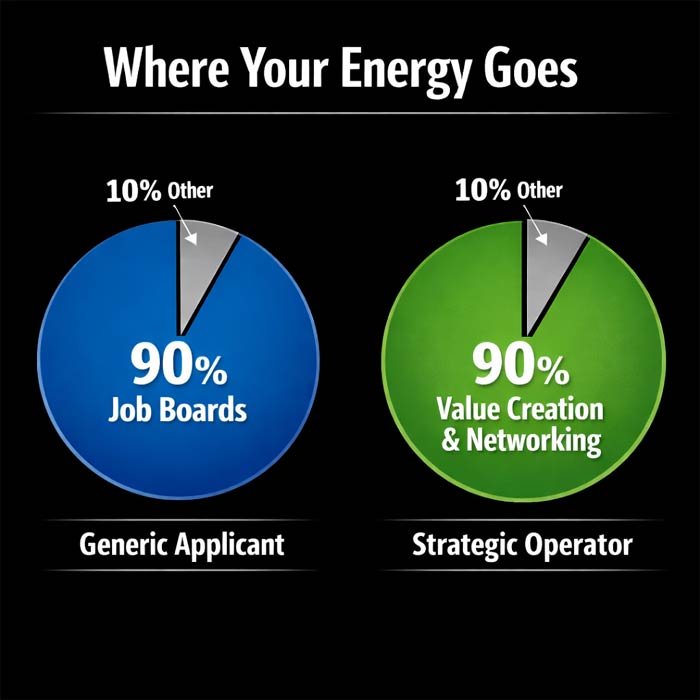
- Invert the Ratio: Spend only 10% of your time on job boards and 90% on networking and peer projects.
- Create a Problem Portfolio: Replace your generic resume with a slide deck proving how you solved specific problems in previous roles.
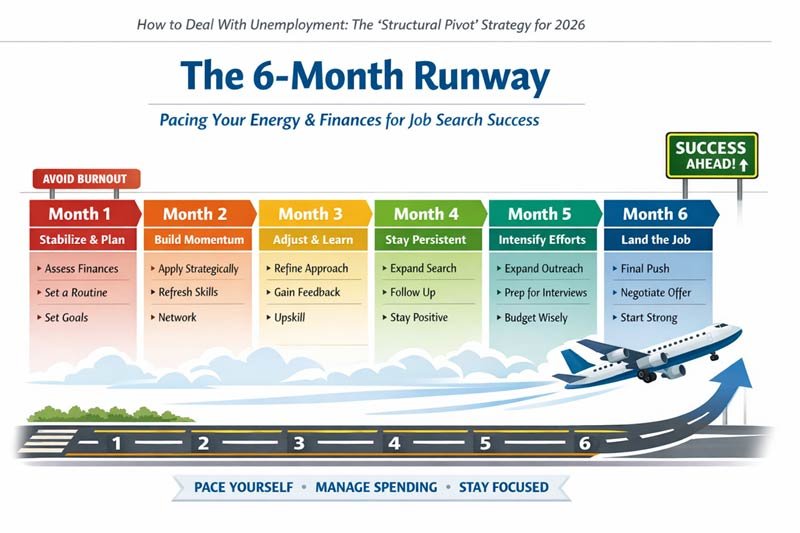
- Adopt Defensive Pessimism: Budget for a 6-month search to reduce daily anxiety and improve interview performance.
Why You Feel Stuck: The “Ghost Job” & AI Trap
If you are wondering why you haven’t received a callback despite sending 200 resumes, the math provides a disturbing answer.
The Math of the “Numbers Game” is Broken
Conventional wisdom suggests that if you apply to enough roles, statistical probability will eventually work in your favor. In 2026, this is mathematically false. High-volume application strategies trigger “Application Fatigue,” degrading the quality of your outreach.
Worse, you are likely applying to jobs that do not exist.
According to recent data from Clarify Capital and ResumeBuilder, approximately 30% of job postings are “Ghost Jobs” – listings that are fake or not currently active. Source. Companies leave these up to harvest data or give the illusion of growth.
The Reality: If you spend three hours applying to jobs today, one of those hours was statistically wasted on roles that will never be filled.
The “Easy Apply” Paradox
The “Easy Apply” button has democratized job applications to a fault. It created a noise floor so high that qualified candidates are buried instantly.
Recruiters on LinkedIn consistently report receiving 500+ applications within 24 hours of posting a role. Of those, the vast majority are unqualified spam. To the Applicant Tracking System (ATS), you are just another data point in a flooded server.
Steps to Recover From Unemployment: The Strategic Pivot
To break this cycle, you must change how you operate. These are the specific steps to recover from unemployment by bypassing the broken front door.
Step 1: Adoption of the 90/10 Rule
Most job seekers spend 90% of their time cold applying and 10% networking. You must invert this ratio immediately.
- The Old Way: “I need to hit my quota of applications today.”
- The New Way: Allocate 10% of your time to cold applications – but only for “Hell Yes” roles where you are a 95% match.
- The 90% Shift: Dedicate the remaining 90% to high-signal activity. This includes peer projects, auditing company problems, and direct outreach to decision-makers.
Step 2: The “Problem Portfolio” (For Non-Creatives)
If you are a designer, you have a portfolio. If you are in Operations, Finance, or Sales, you likely only have a resume. In an AI world, text resumes are commoditized.
To bounce back after job loss, you need a “Problem Portfolio.” This is a simple slide deck or PDF that proves your value using the PPR Framework:
- The Problem: What was broken at your last company?
- The Process: How did you fix it? (Focus on the messy middle).
- The Result: What was the ROI or savings?
Step 3: Becoming a “Fractional Solopreneur”
Even if your goal is a full-time W-2 role, your behavior must mimic a high-level consultant.
Do not walk into an interview waiting for questions. Audit the company beforehand. Find a likely pain point they are facing. When you reach out, send a “Value Proposition” document outlining how you would solve that specific problem in your first 90 days.
This is how you move from “asking for a job” to “proposing a business transaction.”
Coping With Unemployment Stress: A Mindset Shift
Strategy means nothing if you are mentally burned out. Coping with unemployment stress requires rejecting the standard “hustle culture” advice.
Why “Treating It Like a Full-Time Job” Is Toxic
You have likely heard the advice: “Treat your job search like a 9-to-5 job.”
“Findings from meta-analyses support the role of job-search intensity in predicting quantitative employment success outcomes (e.g., number of interviews, job offers)… [and] identify job-search self-regulation and job-search quality as promising constructs for future research.” — Van Hooft, Wanberg, & colleagues (2020).
Why? Because the 8-hour grind leads to cognitive tunnel vision. You become desperate, and that desperation leaks into your interviews. You need mental clarity to perform, and clarity requires rest.
Replace “Toxic Positivity” With “Defensive Pessimism”
People will tell you to “stay positive.” When you have bills to pay, that advice feels dismissive.
Instead, utilize Defensive Pessimism. This is a strategy where you acknowledge the worst-case scenario to neutralize the fear of the unknown.
- Acknowledge: “This search might take 6 months.”
- Plan: “Here is my budget for 6 months.”
- Result: Once you accept the timeline and budget for it, the anxiety drops. You stop panicking about next week and start executing for next month.
Radical Detachment: You Are Not Your Job Status
Unemployment motivation and mindset hinge on one concept: You are not your job. Unemployment is a “Project.” It is not a personality trait.
Set a strict “Clock Out” time. If you decide to search from 9:00 AM to 1:00 PM, then at 1:01 PM, you are done. Close the laptop. Your value as a human is not tied to your response rate on LinkedIn.
FAQ: Common Questions on Bouncing Back
How long does the average job search take in 2026?
For mid-senior professionals ($96k+), the average search has extended significantly. Recent market analysis suggests a timeline of 5 to 8 months. This is not a reflection of your skill, but of the current hiring velocity.
Is it okay to take a break during unemployment?
Yes. A burned-out candidate rarely gets hired; a refreshed one does. Frame this gap in your narrative as a “Sabbatical” or an “Upskilling Period.”
How do I explain a long employment gap?
Frame it as “Selected Intentionality.” You were not “unable” to find a job; you were waiting for the right fit rather than accepting the first offer. Companies respect candidates who are selective about where they bring their value.
Conclusion: From Powerless Applicant to Strategic Asset
The market is tough, but the “Standard Applicant” – the one hitting Easy Apply 50 times a day – is the one struggling the most.
By using the Structural Pivot, you step out of that noisy line. You stop asking for permission and start demonstrating value. You are no longer just a resume in a database; you are a problem solver with a portfolio.
Learning how to deal with unemployment is ultimately about control. Control what you can, clock out when you’re done, and trust the pivot.
Unemployment can be really painstaking, but bouncing back from unemployment is inevitable, provided you have the proper motivation and approach.