Most savings accounts in India pay 2.50% a year. Inflation often eats more than that. So your idle money quietly shrinks.
The fix isn’t always a fixed deposit. Some banks now pay up to 6.50% on the savings balance itself. You just need to know where the slabs begin.
A savings account is a bank deposit you can withdraw anytime. It pays interest on the balance you keep. This guide compares six banks on rates, charges and features, using each bank’s own published data.
Ujjivan Small Finance Bank tops this list. It is primarily high for people with account balance of ₹5 lakh or more, paying 6.50% on balances above ₹5 lakh, credited monthly. AU Small Finance Bank suits zero-balance digital savers. SBI fits people who want no minimum balance at a big bank. HDFC, ICICI and Axis pay 2.50% and need higher balances.
Which are the top 6 banks for savings accounts in India?
The top 6 banks for savings accounts are Ujjivan SFB, AU SFB, SBI, HDFC, ICICI and Axis. We ranked them on interest earned, balance rules, charges and digital access.
Here’s the short version. Below ₹3 lakh, every bank on this list pays 2.50%. Above ₹5 lakh, the gap gets wide.
| Bank and account | Interest rate (p.a.) | Interest credit | Minimum balance | Penalty for low balance | Debit card fee |
|---|---|---|---|---|---|
| 1. Ujjivan SFB, Digital Savings | 2.50% to 7.15% (slabs) | Monthly | ₹1,000 MAB | ₹25 or ₹50 | RuPay Classic free in year 1, then ₹125 a year |
| 2. AU SFB, Digital Savings | 2.50% to 7.00% (slabs) | Monthly | Nil | Not applicable | RuPay Platinum; replacement ₹200 |
| 3. SBI, Savings Bank Account | 2.50% flat | Nil | None | ₹200 a year from year 2 (Classic) | |
| 4. HDFC Bank, Regular Savings | 2.50% flat | Quarterly | ₹10,000 AMB (metro/urban) | 6% of shortfall or ₹600, whichever is lower | ₹200 to ₹500 a year, by card |
| 5. ICICI Bank, Standard Savings | 2.50% flat | Quarterly | ₹15,000 MAB (metro/urban) | 6% of shortfall or ₹500, whichever is lower | ₹300 a year |
| 6. Axis Bank, Easy Access Digital | 2.50% flat | Quarterly | ₹12,000 (metro/urban) | ₹6 per ₹100 short, capped by location | ₹500 a year + GST |
Sources: Each bank’s official savings account page and schedule of charges. It was checked on 4 October 2026. GST applies to charges. Fees change, so confirm on the bank’s site before you open an account.
How do savings account interest slabs work?
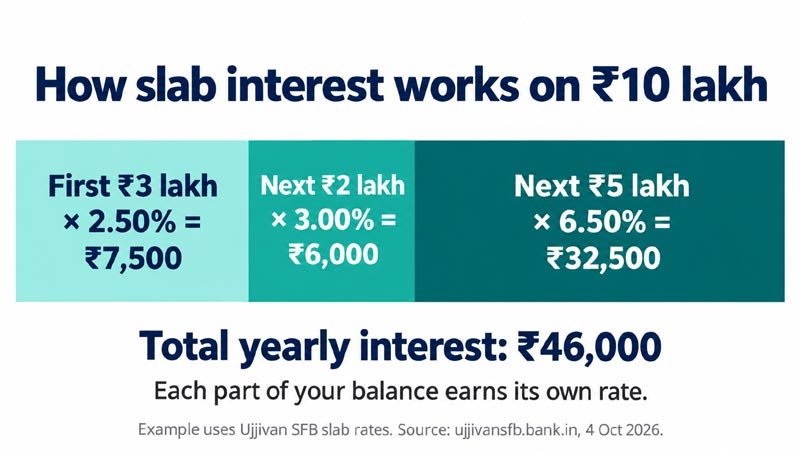
An interest slab is a balance band with its own rate. At slab-based banks, each band of your money earns its own rate.
Ujjivan and AU use incremental slabs. Your first ₹3 lakh earns 2.50%, and only the money above it earns more.
Many people miss this detail.
Here are Ujjivan Small Finance Bank’s current slabs, from its savings account page:
- Up to ₹3 lakh: 2.50%
- Above ₹3 lakh to ₹5 lakh: 3.00%
- Above ₹5 lakh to ₹25 lakh: 6.50%
- Above ₹25 lakh to ₹25 crore: 6.75%
- Above ₹25 crore: 7.15%
AU Small Finance Bank also starts at 2.50%. Its 6.50% slab begins only at ₹10 lakh, according to AU’s rate page (effective 1 October 2026).
Ujjivan’s 6.50% kicks in at ₹5 lakh. That ₹5 lakh head start is the main reason Ujjivan ranks first here.
How is savings account interest calculated and credited?
Banks calculate savings interest on your daily closing balance. They then credit it monthly or quarterly.
The formula is simple:
Interest = Daily balance × Rate × Days ÷ 365
If you keep ₹50,000 for 30 days at 2.50%. You earn about ₹103 for that month.
Credit frequency matters more than people think. Ujjivan and AU credit interest every month. HDFC, ICICI and Axis credit it every quarter.
Monthly credit means your interest starts earning interest sooner. The gain is tiny on small balances. On ₹20 lakh, it adds up over the years.
How much interest will you earn at different balances?
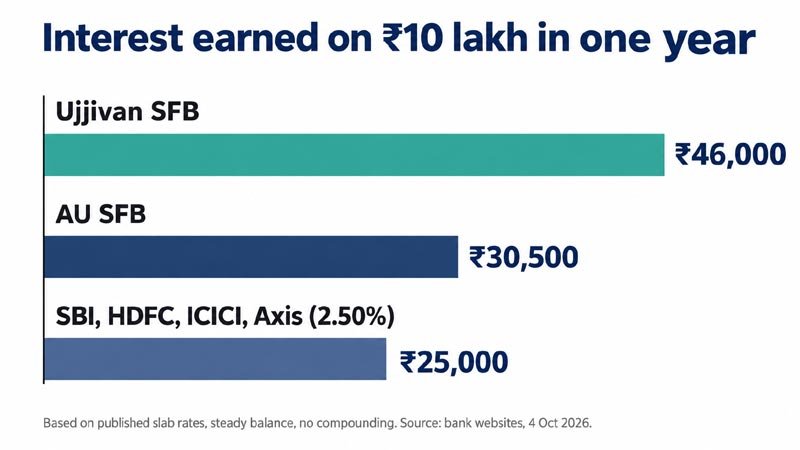
We ran the numbers using each bank’s published slabs. These figures are yearly, assume a steady balance, and ignore compounding.
| Balance kept all year | Ujjivan SFB | AU SFB | SBI, HDFC, ICICI, Axis (2.50%) |
|---|---|---|---|
| ₹1 lakh | ₹2,500 | ₹2,500 | ₹2,500 |
| ₹5 lakh | ₹13,500 | ₹13,000 | ₹12,500 |
| ₹10 lakh | ₹46,000 | ₹30,500 | ₹25,000 |
| ₹25 lakh | ₹1,43,500 | ₹1,28,000 | ₹62,500 |
Look at the ₹10 lakh row. Ujjivan pays ₹21,000 more than a 2.50% account. That’s a decent weekend holiday, every year, for doing nothing.
Here’s a worked example. Priya, a freelance designer in Hyderabad, keeps ₹10 lakh as her emergency and tax fund. At a big private bank, it earned her ₹25,000 a year.
In a slab-based account, the same money earns ₹46,000. She didn’t lock it in an FD, so she can still pay her GST on time.
What does each of the top 6 savings accounts offer?
Each bank suits a different kind of saver. Here’s who should pick which.
1. Ujjivan Small Finance Bank: best for balances above ₹5 lakh
Ujjivan Small Finance Bank is a Bengaluru-headquartered bank with branches across India. Its Digital Savings Account pays up to 7.15% and credits interest every month.
The minimum is ₹1,000 MAB. Fall to ₹500 to ₹999 and you pay ₹25. Below ₹500, the charge is ₹50, as per Ujjivan’s schedule of charges effective 1 August 2026.
Other charges in that schedule:
- RuPay Classic debit card: free issuance, ₹125 AMC from the second year
- RuPay Platinum debit card: ₹299 issuance, ₹250 AMC from the second year
- ATMs: 5 free financial transactions a month, then ₹23 each; ₹10 per non-financial transaction
- Failed cash withdrawal for low balance: ₹25
- Cash withdrawal at a shop (POS): 1% of the amount
- Cash deposit: free up to ₹2.5 lakh a month, then ₹4 per ₹1,000
You can open the account with Video KYC. The Hello Ujjivan app handles UPI, NEFT, RTGS, IMPS, bill payments and card limits.
Every Ujjivan variant follows the same rate slabs. The difference lies in balance rules and perks:
- Digital Savings Account: ₹1,000 MAB and paperless opening. Suits salaried people and freelancers who bank on the phone.
- Regular Savings Account: ₹1,000 MAB with a RuPay Classic card. Suits modest savers who like visiting a branch.
- Classic Savings Account: choice of Classic or Platinum card, ₹1 lakh daily shopping limit, free quarterly cheque books. Suits frequent card users.
- Privilege Savings Account: ₹25,000 balance, unlimited free fund transfers and free Ujjivan ATM use. Suits people who move money often.
- Maxima Savings Account: zero charges on common services and ₹10 lakh personal accident cover. Suits high-balance customers.
- Senior Citizen Savings Account: for people aged 60+, with a senior desk and no balance maintenance charges.
- Garima Savings Account: for women, with flexible balance options and a linked minor account.
- Minor Savings Account: no balance criteria, run by a parent or guardian.
- Basic Savings Bank Deposit Account (BSBDA): no balance penalty and 4 free withdrawals a month. Suits first-time savers.
Best for: savers with ₹5 lakh or more who want easy access to their money.
Watch out: below ₹3 lakh, Ujjivan pays the same 2.50% as everyone else. You also need to keep ₹1,000, while AU and SBI need nothing.
2. AU Small Finance Bank: best zero-balance digital account
AU Small Finance Bank’s Digital Savings Account needs no minimum balance. It pays up to 7.00% and credits interest every month.
Interest is calculated daily on incremental slabs. These rates are from AU’s rate page, effective 1 October 2026:
- Below ₹3 lakh: 2.50%
- ₹3 lakh to ₹5 lakh: 2.75%
- ₹5 lakh to ₹10 lakh: 3.50%
- ₹10 lakh to below ₹25 crore: 6.50%
- ₹25 crore to below ₹100 crore: 6.75%
- ₹100 crore to below ₹750 crore: 7.00%
Charges from AU’s Digital Savings fee schedule (effective 1 May 2025):
- Minimum balance: nil, so no non-maintenance charge
- AU ATMs: 10 free financial transactions
- Other-bank ATMs: 5 free a month, then ₹23 financial and ₹10 non-financial
- ATMs outside India: ₹100 financial, ₹25 non-financial
- Cash deposit: free for 5 deposits or ₹1 lakh a month, whichever comes first; then ₹5 per ₹1,000
- Debit card replacement: ₹200 per instance
- Cheque, ECS or NACH return: ₹500 per instance
- SMS alerts: ₹0.30 each, capped at ₹15 a quarter
The AU 0101 app covers UPI, IMPS, NEFT, RTGS and bill payments. Online RTGS, NEFT, UPI and intra-bank transfers are free. AU also offers video banking, which helps if you dislike branch queues.
Best for: digital savers who never want to track a minimum balance.
Watch out: between ₹5 lakh and ₹10 lakh, AU pays 3.50%. Free cash deposits stop at ₹1 lakh a month.
3. SBI: best for no minimum balance at a large bank
SBI’s Savings Bank Account pays 2.50% on every balance, effective 15 June 2025. There’s no minimum balance, so there’s no penalty. There’s no maximum balance either, per SBI’s product page.
Charges from SBI’s service charge schedule:
- SBI ATMs: 10 free cash transactions a month, then ₹15 per financial transaction; balance checks are free
- Other-bank ATMs: 5 free, then ₹21 financial and ₹10 non-financial
- Debit card: Classic, Silver, Global and Contactless cards are free to issue; ₹200 a year from year two
- Cheque book: first 10 leaves free each financial year. After that, ₹40 + GST for 10 leaves, ₹75 + GST for 25
YONO, internet banking and mobile banking cover daily payments. SBI Quick lets you check your balance with a missed call. That’s handy on a basic phone.
Best for: people who want zero balance stress, a huge branch network and cheap ATM use.
Watch out: you earn 2.50% whether you keep ₹10,000 or ₹10 lakh.
4. HDFC Bank: best for card perks and shopping offers
HDFC Bank’s Regular Savings Account pays 2.50% on all balances, revised from 24 June 2025. Interest is calculated on daily balances and credited quarterly.
Balance rules depend on where your branch is, per HDFC’s product page:
- Metro and urban: ₹10,000 AMB, or an FD of ₹1 lakh for 1 year and 1 day
- Semi-urban: ₹5,000, or an FD of ₹50,000
- Rural: ₹2,500, or an FD of ₹25,000
Other charges in HDFC’s service fee schedule:
- Low balance: 6% of the shortfall or ₹600, whichever is lower
- Debit card: Millennia and Rewards ₹500 a year, MoneyBack ₹300, RuPay Platinum ₹200
- HDFC ATMs: 5 free transactions a month
- Other-bank ATMs: 3 free in six metros, 5 elsewhere; then ₹23 cash and ₹8.50 non-financial
- Cheque bounce for low funds: ₹500 for the first in a month, ₹550 after that
- Closing the account between 15 days and 1 year: ₹500
Perks include SmartBuy offers, BillPay, free email statements and a Super Saver facility. Your first Demat account gets a first-year AMC waiver. NetBanking, PhoneBanking and MobileBanking handle daily needs.
Best for: online shoppers who can hold ₹10,000 without effort.
Watch out: the FD route around the AMB locks ₹1 lakh for over a year.
5. ICICI Bank: best for investors who want a 3-in-1 account
ICICI Bank’s Standard Savings Account pays 2.50% on all balances. Interest is calculated on the daily closing balance and credited quarterly.
For accounts opened from 1 August 2025, the minimum balance is:
- Metro and urban: ₹15,000
- Semi-urban: ₹7,500
- Rural: ₹2,500
Some programme customers, pensioners and select students may be exempt. Charges from ICICI’s savings account schedule:
- If your balance falls short: The charge is 6% of the shortfall, capped at ₹500. You may qualify for a waiver if you hold an eligible fixed deposit.
- Debit card fees: The annual fee is ₹300, or ₹150 at Gramin locations. A replacement card costs ₹300.
- Using an ICICI ATM: You get five free transactions. After that, each financial transaction costs ₹23.
- Using another bank’s ATM: Three transactions are free in the six metros, while five are free elsewhere. Once you use these up, the charge is ₹23 for a financial transaction and ₹8.50 for a non-financial transaction.
- Cash transactions at a branch: Each month, you get three free deposits and three free withdrawals, with separate limits of ₹1 lakh for deposits and withdrawals. Beyond these limits, the charge is ₹150 or ₹3.50 per ₹1,000, whichever is higher.
- SMS alerts: Each alert costs ₹0.15, with total charges capped at ₹100 per quarter.
You can link the account with ICICI Demat and trading accounts through its 3-in-1 facility. Debit cards include cover for air accidental death and personal accidental death, subject to the applicable terms. The iMobile app also lets you manage card settings and use SmartLock to control access to banking services.
Best for: active stock investors who want banking and trading in one place.
Watch out: ₹15,000 is the highest metro minimum on this list. Branch cash beyond the free limit costs at least ₹150 a time.
6. Axis Bank: best for high debit card limits and rewards
Axis Bank’s Easy Access Digital Savings Account pays 2.50% on daily balances, credited quarterly. You can open it with video KYC, per Axis Bank’s product page.
The minimum balance is ₹12,000 in metro and urban areas. It drops to ₹5,000 in semi-urban and ₹2,500 in rural areas.
Charges from the Axis fee master (revised schedule effective 1 March 2026):
- Balance shortfall: The charge is ₹6 for every ₹100 below the required balance, capped at ₹300 in semi-urban areas and ₹150 in rural areas.
- Debit card fees: The physical card is issued free, with an annual fee of ₹500 plus GST thereafter. The listed fee for a virtual card is ₹500 plus GST.
- Axis ATM withdrawals: You get five free financial transactions.
- Other banks’ ATMs: Three transactions are free in the six metros and five elsewhere. After that, financial transactions cost ₹23 each, while non-financial transactions cost ₹10.
- Branch transactions: The first 15 transactions each month are free. Each additional transaction costs ₹75.
- Cash transactions beyond the limits: The charge is ₹5 per ₹1,000 for self transactions and ₹10 per ₹1,000 for third-party transactions, subject to a minimum charge of ₹150.
With the Rewards debit card, you can withdraw up to ₹40,000 a day from ATMs and spend up to ₹1 lakh a day on shopping. The card also offers purchase protection and cashback deals. For everyday banking, the Axis Open app provides over 250 services, including options to open fixed and recurring deposits instantly.
Best for: heavy debit card spenders who want rewards and high limits.
Watch out: the card fee of ₹500 + GST a year is on the high side.
What charges should you check before opening a savings account?
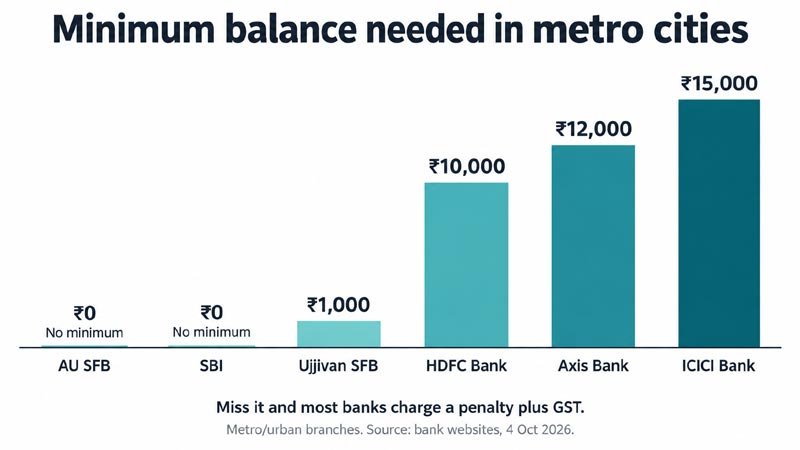
Check five charges: low-balance penalty, debit card AMC, ATM fees, cash deposit limits and cheque book costs. These can wipe out a year of interest on small balances.
ATM fees are a good example. From 1 May 2025, the RBI let banks charge up to ₹23 per ATM transaction beyond the free limit. All India Radio News reported the change in March 2025.
Here’s how the six banks compare on ATM and cash limits:
| Bank | Free at own ATMs | Free at other ATMs | Fee after free limit | Free cash deposits |
|---|---|---|---|---|
| Ujjivan SFB | 5 a month, all ATMs combined | Included in the 5 | ₹23 | Up to ₹2.5 lakh a month |
| AU SFB | 10 | 5 | ₹23 | 5 deposits or ₹1 lakh a month |
| SBI | 10 | 5 | ₹15 own, ₹21 other | |
| HDFC Bank | 5 | 3 in six metros, 5 elsewhere | ₹23 | |
| ICICI Bank | 5 | 3 in six metros, 5 elsewhere | ₹23 | 3 deposits, up to ₹1 lakh a month |
| Axis Bank | 5 | 3 in six metros, 5 elsewhere | ₹23 |
Penalties hurt more. Keep ₹5,000 in an ICICI metro account and you fall ₹10,000 short. That costs you ₹500 plus GST, in one month.
Your yearly interest on ₹5,000 is only about ₹125. Ouch.
Follow these steps before you sign up:
- Find your realistic monthly balance. Be honest about the lean months.
- Match it to a bank’s minimum balance rule.
- Download the bank’s schedule of charges PDF, not just the product page.
- Count your ATM visits and cash deposits in a typical month.
- Add the debit card AMC from year two.
- Compare total yearly charges with the interest you’ll earn.
Are small finance banks safe for your savings?
Yes. Small finance banks are scheduled commercial banks licensed and regulated by the Reserve Bank of India. Their deposits carry the same insurance as SBI or HDFC deposits.
The Deposit Insurance and Credit Guarantee Corporation (DICGC) insures up to ₹5 lakh per depositor, per bank. That covers savings, FDs and RDs together.
Key Takeaways
- All six banks pay 2.50% below ₹3 lakh. Pick based on charges and convenience.
- Ujjivan SFB’s 6.50% slab starts at ₹5 lakh. ₹10 lakh earns about ₹46,000 a year.
- HDFC, Axis and ICICI need ₹10,000 to ₹15,000 in metros, or you pay a penalty.
- AU SFB and SBI need no minimum balance at all.
- DICGC insures up to ₹5 lakh per depositor, per bank, including small finance banks.
Frequently Asked Questions
Which bank gives the highest savings account interest rate in India?
Among the six banks here, Ujjivan Small Finance Bank pays the most, up to 7.15% on very large balances. For everyday savers, its 6.50% rate on balances above ₹5 lakh matters more. Big banks like SBI, HDFC and ICICI pay 2.50%.
Is the 7.15% rate paid on my whole savings balance?
No, it applies only to the part of your balance above ₹25 crore. Ujjivan uses incremental slabs, so each band earns its own rate. Your first ₹3 lakh always earns 2.50%.
Which savings account has no minimum balance requirement?
SBI’s Savings Bank Account and AU Small Finance Bank’s Digital Savings Account have no minimum balance. Ujjivan’s BSBDA and Minor Savings Account also carry no balance penalty. Most other accounts need a monthly or average balance.
Is my money safe in a small finance bank like Ujjivan?
Ujjivan is regulated by the RBI, and its eligible deposits have DICGC insurance. The cover is up to ₹5 lakh per depositor, per bank, including both your deposit and the interest earned. Accounts held in the same name and ownership capacity at that bank count together, even across branches. For larger amounts, spreading deposits across different insured banks can bring more of your savings within the cover.
How often is savings account interest credited?
It depends on the bank. Ujjivan and AU credit interest monthly, while HDFC, ICICI and Axis credit it quarterly. Monthly credit lets your interest start compounding sooner.